
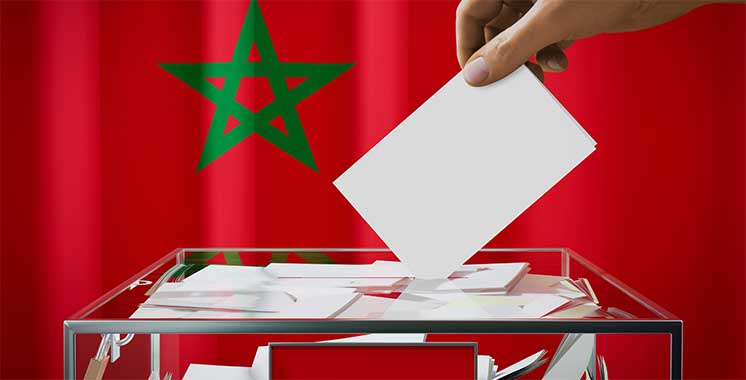
Morocco has published two new decrees in the Official Gazette formally establishing the legal framework for the financing of the September 23,2026 legislative elections,a set of regulations that,for the first time,explicitly address the use of artificial intelligence,social media,and digital platforms in electoral campaigns and place them under the authority of spending ceilings and state oversight.
The September date had already been confirmed by a previous government council decree,but the new texts fill out the regulatory architecture that will govern how candidates may spend,and what the state will contribute.
The principal decree sets the overall spending ceiling for each candidate at 600,000 dirhams for the general election campaign. Within this envelope,digital campaign spending — defined as covering all social media platforms,AI tools,digital applications,and internet-based software — is capped at one third of the total individual budget. For local candidate lists,the ceiling for online spending is set at 800,000 dirhams; for regional lists,the cap rises to 1.5 million dirhams. The explicit inclusion of AI tools in the definition of regulated campaign expenditure is a notable regulatory first in Morocco.
Another accompanying decree addresses the state’s contribution to party campaign financing. Under Morocco’s electoral framework,parties that reach certain thresholds in legislative elections are entitled to public subsidies for their campaign costs — a mechanism designed to reduce the structural advantage of well-funded parties and to partially democratize access to the electoral arena. The updated decree brings the subsidy framework into alignment with the new overall spending architecture.
The regulatory package also includes amendments to the organic law governing the Chamber of Representatives,and a companion organic law on political parties. The electoral law revisions introduce tighter eligibility criteria: candidates under criminal prosecution for serious offences or who have been dismissed from representative positions are ineligible. The law also reopens the possibility of holding a deputy’s mandate concurrently with the presidency of a provincial or communal council serving over 300,000-strong populations— a provision that had been restricted in the 2021 cycle. The party law reform raises the minimum founding membership to 2,000 members distributed across all regions,with at least one fifth being women and one fifth being under 35.
The election observation process is also formally under way: the Accreditation Commission for Election Observers,chaired by CNDH President Amina Bouayach,has opened applications for accreditation of both national and international observer organizations,with a submission deadline set for May 22.
Morocco’s 2026 elections — taking place five years after the 2021 cycle and ahead of the 2030 World Cup — carry significant political weight as the last parliamentary mandate before what promises to be a decade of transformative national development.

United News - unews.co.za