
Researchers in Switzerland have 3D printed the most true-to-life human ear yet created in a laboratory using patients’ own cartilage cells.
For more than three decades,scientists have been trying to produce a functional ear from living tissue.
In 2016,a team led by ETH professor Marcy Zenobi-Wong attracted international attention after creating a 3D-printed ear.
However,though aesthetically similar,the ear lacked some of the properties and flexibilities of our own.
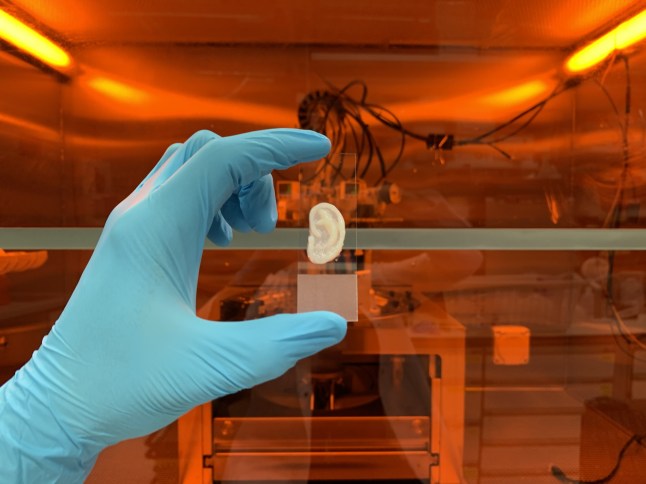
An incredibly life-like human ear created using a 3D printer after years of work (Picture: Philipp Fisch/ETH Zurich/Cover Images)
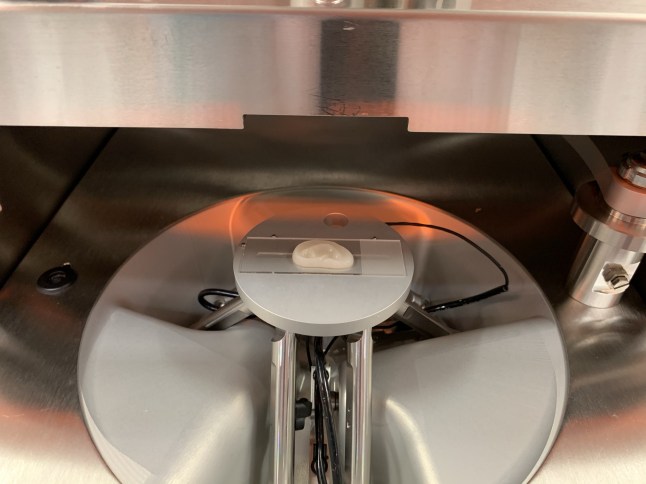
An ear being created. Researchers used cartilage cells from the patient to get the best possible result (Picture: Philipp Fisch/ETH Zurich/Cover Images)
Now,researchers from ETH Zurich,the Friedrich Miescher Institute and the Cantonal Hospital of Lucerne say they have moved an important step closer to replicating the properties of a natural ear.
Using human ear cartilage cells,the team has produced elastic cartilage in the laboratory with mechanical characteristics similar to those of real tissue. In animal tests,the engineered cartilage retained its shape and elasticity after six weeks.
The work could have important implications for people who lose part or all of an ear as a result of accidents or fires,as well as for children born with congenital malformations of the outer ear. One such condition,microtia,affects around four in every 10,000 children.
Currently,reconstruction usually involves taking cartilage from a patient’s ribs – a painful procedure that can cause scarring and chest deformities. The reconstructed ear is also often stiffer than a natural one.
Philipp Fisch,the lead author of the study published in Advanced Functional Materials,is a senior researcher in the Tissue Engineering and Biofabrication Group led by Marcy Zenobi-Wong.
He said: ‘We aren’t implanting soft tissue in the hope that it remains stable in the body. Instead,we want to achieve that stability in the laboratory.’
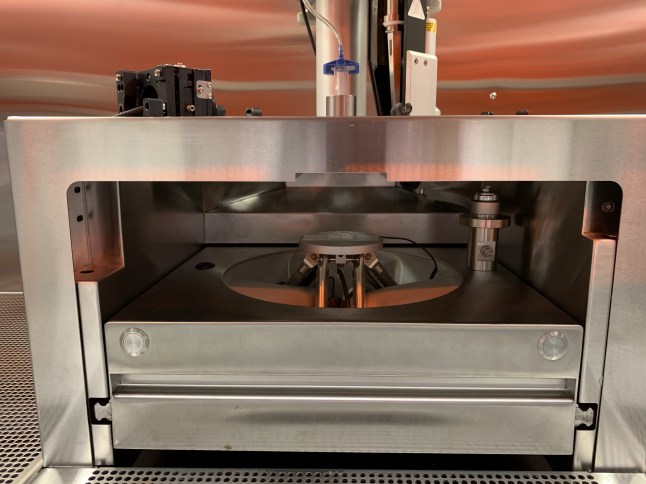
The printing machine in the laboratory in Zurich (Picture: Philipp Fisch/ETH Zurich/Cover Images)
One of the biggest challenges,the researchers say,is elastin – the protein that gives ears their flexibility.
Scientists must not only produce elastin,but also ensure it forms a stable network that lasts over time. So far,a precise biological “blueprint” for achieving this remains unknown.
To create the cartilage,the team extracted cells from small remnants removed during routine ear-correction surgeries. Although a tiny tissue sample contains about 100,000 cells,a full ear requires several hundred million.
The cells were therefore multiplied in the laboratory using a nutrient-rich solution and a specially designed culture environment to ensure even growth.
Researchers also tested growth factors to encourage the cells to divide,while preventing them from behaving like fibroblasts – cells that can produce scar tissue. The aim was to generate true ear cartilage,rich in type II collagen and elastin.
The expanded cells were then embedded in a gel-like ‘bioink’ and shaped into ears using a 3D printer. Initially,the printed structures were very soft.
‘While the input material is crucial,so too is the tissue’s ability to develop,”’ Fisch said.
The ears were matured in an incubator for several weeks,allowing the tissue to strengthen.
Fisch identified four factors that were key to the breakthrough.
‘We optimised cell proliferation,adjusted the material properties,increased the cell density and controlled the maturation environment more effectively,’ he said.
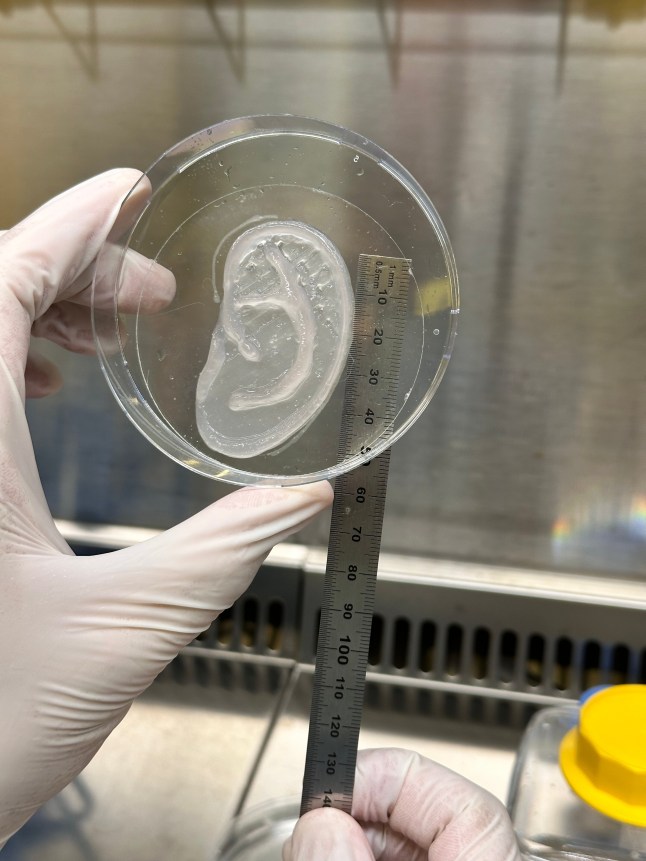
Using patient cartilage has made the ears much more elastic and closer to the functionality of the human equivalent (Picture: Philipp Fisch/ETH Zurich/Cover Images)
After about nine weeks of laboratory maturation,the ear structures were implanted under the skin of rats. Six weeks later,they were found to be stable and mechanically similar to natural cartilage.
However,challenges remain. Only a small number of research groups worldwide are working on producing elastic ear cartilage,and progress is slow. A single experiment can take three to four months,as researchers test multiple conditions in an effort to uncover the elusive elastin blueprint.
‘We’ve been working on this problem in our group for over ten years,’ Fisch said. ‘When it comes to biofabrication of tissue,or tissue engineering as it’s also known,swift progress is rare to see.’
Interest in the research is already growing.
‘The study had barely been published before I received a message from the parents of a child with microtia,’ he added. ‘They wanted to know how soon the technology might reach clinical trials.’
For now,Fisch remains cautiously optimistic. ‘If all goes well,we hope to find the blueprint for the elastin network within the next five years,’ he said.

United News - unews.co.za