
Get ready for your close-up (Picture: Getty)
OpenAI has added age prediction features to ChatGPT in a bid to make its flagship chatbot safer for teenagers.
Rather than simply ticking a box to say you’re over-18,the AI-powered virtual assistant will use ‘behavioural signals’ to guess someone’s age.
This could involve ChatGPT looking at how long you’ve had an account for and activity patterns,like if it’s consistent with school hours.
Age prediction doesn’t happen the second someone makes an account – the system will run in the background,OpenAI says.
If the bot believes you’re under-18,it’ll restrict the kind of content you can see,such as gore,risky viral challenges,eating disorders or adult content.
Those who are mistakenly labelled as underage can upload a scan of a government ID or a selfie to be analysed by an identity-verification service.
When a Metro reporter verified their age,ChatGPT asked to enable their laptop’s camera to film them,which was scanned to estimate their age.
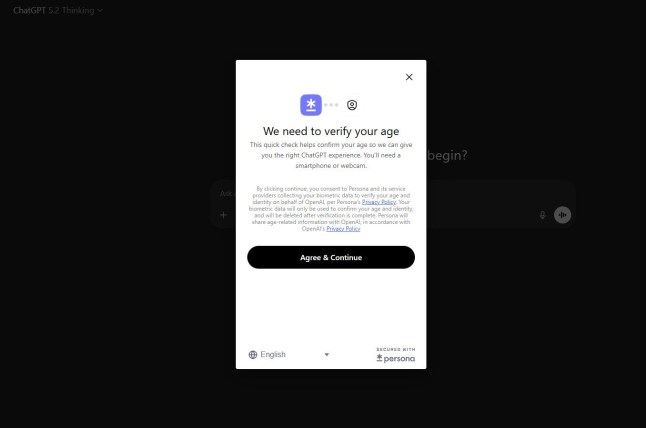
A pop-up asks people to verify their age (Picture: ChatGPT)
They were asked to look at the camera before looking left and right.
After the system believed them to be an adult,a pop-up appeared,reading: ‘You’ll soon be able to use all ChatGPT features available to adults over 18.
‘It may take a bit for everything to refresh.’
If a user self-reports their age as under 18,safeguards automatically kick in to prevent them from seeing harmful content.
OpenAI says: ‘This also enables us to treat adults like adults and use our tools in the way that they want,within the bounds of safety.’
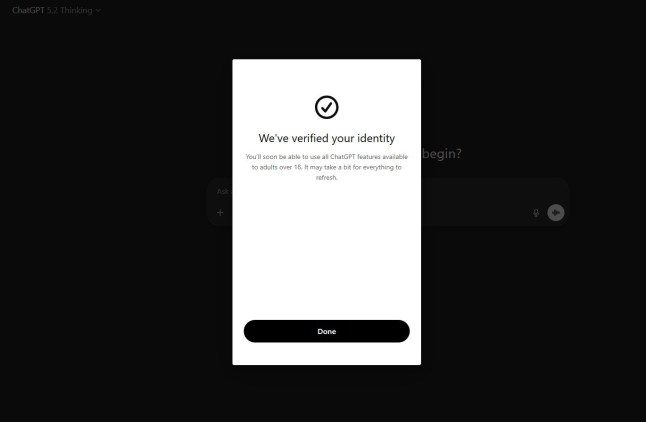
Age checker Persona examines the selfie (Picture: ChatGPT)
Common Sense Media,a non-profit which gives age-range suggestions for TV and movies,welcomed the announcement.
The organisation’s senior director for AI programs,Robbie Torney,told Metro: ‘This is not the only thing that’s needed to keep kids safe online. In particular,this will intersect with model policies for minors and how effective guardrails are.
‘We need to test this out to make sure it works as intended,so we’ll be evaluating this new feature to see how it works.’
The AI giant has been criticised in recent years for the impact that ChatGPT can have on children and teenagers.
More than half of teens in the UK have turned to AI for emotional support in the last year,alarming mental health experts who stress that general-purpose chatbots like ChatGPT are not therapists.
There have also been cases in which the system has made things up or allegedly led to tragic outcomes.
ChatGPT already has various safeguards (Picture: Getty Images)
Last April,OpenAI had to address a glitch that allowed ChatGPT to churn out erotic material for underage users.
OpenAI said in a blog post yesterday that the age prediction is rolling out except in the European Union,where it will be introduced in a few weeks ‘to account for regional requirements’.
‘While this is an important milestone,our work to support teen safety is ongoing,’ OpenAI added.
‘We’ll continue to share updates on our progress and what we’re learning,in dialogue with experts including the American Psychological Association,ConnectSafely,and Global Physicians Network.’
The age-guessing features come after OpenAI launched parental controls last year,allowing guardians to oversee their teens’ accounts.
Parents are also notified if the child is showing potential signs of distress and can set specific times when ChatGPT can be used.
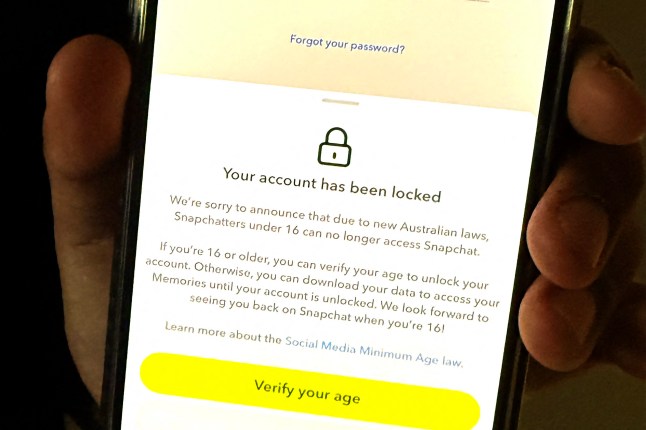
Australia has banned underage children and teens from using social media altogether (Picture: AFP via Getty Images)
OpenAI’s developer community had been requesting the feature for more than a year to help prevent misuse in the age of ‘digital parenting’.
The features were developed with Common Sense Media.
ChatGPT isn’t alone in turning to age-checking tech,often called age-gating.
Social media titans Instagram, YouTube and TikTok,as well as the gaming platform Roblox,have all restricted children’s accounts in recent months.
Instagram,for example,uses AI models to rummage through a person’s inbox to see if they have received a message saying: Happy 16th birthday.’
Australia has even gone so far as to ban youngsters from having social media accounts,something that the UK is considering implementing.
But Rob Jardin,the chief digital officer at NymVPN,told Metro that age-guessing systems should not be treated like definitive identity checks.
‘The bigger risk isn’t age checks themselves,but how these systems can start being used for more than they were originally designed for,’ he said.
‘Once technology exists to guess who you are or how old you might be,there is a strong incentive to reuse it for advertising,profiling,or other forms of monitoring.’

United News - unews.co.za