
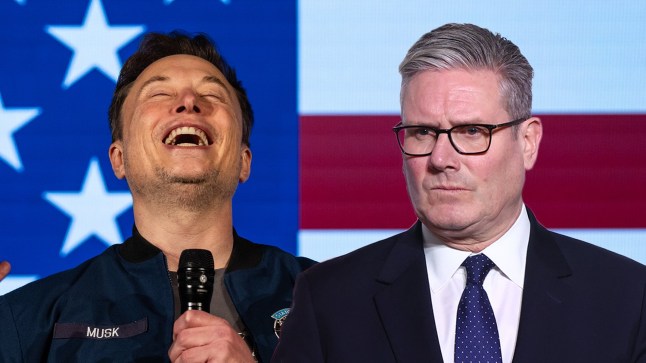
Elon Musk hits back at Sir Keir Starmer with AI bikini picture of PM (Picture: Getty)
Elon Musk has hit back at Sir Keir Starmer and blasted critics of X,saying they ‘want any excuse for censorship’.
The billionaire appeared defiant on Friday night despite the outcry over reports X’s AI chatbot Grok was creating sexualised images of people,including children,at users’ request.
The prime minister has said he will leave ‘all options’ open in response to the widespread fury at the social media site.
Musk later reposted an AI-generated image of Sir Keir in a bikini,saying ‘they just want to suppress free speech’.
Ofcom is now deciding what to do with the social media giant’s artificial intelligence (AI) chatbot.
Technology Secretary Liz Kendall said today she would back the media regulator if it decided to ban X over non-compliance with UK laws.
Kendall said: ‘Sexually manipulating images of women and children is despicable and abhorrent.’
She added: ‘I,and more importantly the public,would expect to see Ofcom update on next steps in days,not weeks.’
Ofcom told Metro earlier that after giving X a deadline for today,the platform finally ‘explained themselves’.
‘We’re now undertaking an expedited assessment as a matter of urgency and will provide further updates shortly,’ a spokesperson added.
The Information Commissioner’s Office (ICO) also confirmed to Metro earlier this week that the data protection watchdog was in talks with X.
Grok is built into X and is free for all users (Picture: Getty Images AsiaPac)
X users are able to ask Grok – by tagging @grok in a tweet – to edit or create images on the platform.
Since late December,however,Grok has at times made dozens of degrading images of women every minute.
Metro saw an example today of a user asking Grok to forge a photograph of a woman ‘holding a baby and pulling down her clothes to breastfeed’.
In another,an anonymous X user asked the virtual assistant to unclothe a group of women by telling it that ‘they are men’.
Some users are now receiving automated responses saying that ‘image generation and editing are currently limited to paying subscribers’.
Free users can still edit images on X through its ‘edit image’ function,or on Grok’s app and website.
Under the Online Safety Act (OSA),a bill that regulates online material,it is illegal to create or share intimate or sexually explicit images.
The Centre for Policy Studies questioned whether Ofcom can go far enough to protect users.
The think-tank’s communication and digital manager,MeIisa Tourt,told Metro ‘The OSA’s remit is strictly limited to user-to-user and search services,meaning it does not regulate AI models themselves until their output is shared.

Grok is built into X (Picture: Mateusz Slodkowski/SOPA Images/LightRocket via Getty Images)
‘To complicate matters,the OSA mandates that platforms treat “bots” as normal users,meaning that while a human might prompt a deepfake,the legal act of “sharing” is often performed by the platform’s own @Grok account.
‘This creates a regulatory blind spot that Ofcom may struggle to navigate with current enforcement tools.’
Tourt added that the law is murky around ‘deepfakes’ as it excludes images that show something ‘originally seen in public’,such as a bikini.
‘We risk ending up in a bizarre situation where posting a real non-consensual image of someone in a bikini is legal,but generating a fake one could theoretically carry a two-year prison sentence,’ she said.
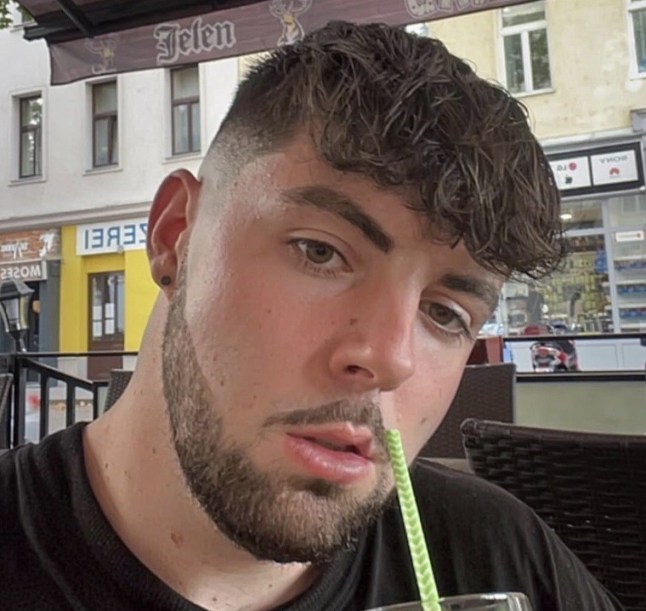 Ruben Chorlton-Owen said his Instagram images have been edited (Picture: Ruben Chorlton-Owen)In one exchange seen by Metro,a troll asked Grok to strip Ruben,with the bot making a synthetic image of the musician shirtless.Under xAI’s acceptable use and privacy policies,users are prohibited from creating or sharing content that harms people.But Ruben,24,questioned whether X’s policies were robust enough.‘It made me feel exposed and powerless,and highlighted how little control people have over their own images once online and myself as a content creator,whose photos are already accessible,’ he added.
 Grok hoovers up huge amounts of data to ‘learn’ how to create content (Picture: Getty Images)‘It is producing a sexualised deepfake of a real person without their consent and in UK law that can amount to a serious breach of privacy,data protection rights and potentially criminal law.‘There are also data protection implications. Using a person’s likeness to generate sexualised content without consent can constitute unlawful processing of biometric data. ‘From a civil law perspective,individuals may have claims for misuse of private information or harassment.’
United News - unews.co.za