

It’s not quite ‘Star Trek’,one of the lead authors told Metro (Picture: Getty/Metro)
With just a push of a button,you soon might be able to teleport from your home to the office (or the local pub).
Well,you could do that,if you were a piece of information being whizzed from one computer to another two metres away,rather than a human.
Researchers in Oxford have managed to ‘teleport’ information without sending a traditional physical signal.
Unfortunately,it doesn’t mean there are actually experiments at the uni where students are being sent from lab to lecture without ever moving.
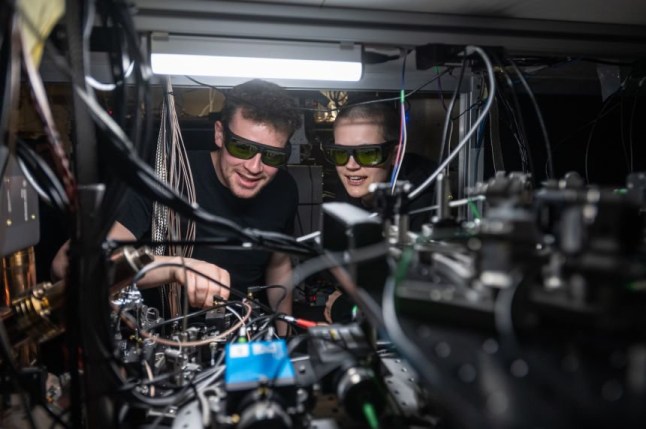
Dougal Main and Beth Nichol working on their quantum computer (Picture: John Cairns)
Instead,the teleportation of data shows that we could build an exponentially powerful computer long thought to be the stuff of science fiction.
In the study,published in the journal Nature,scientists linked up two separate processors to form a single quantum computer.
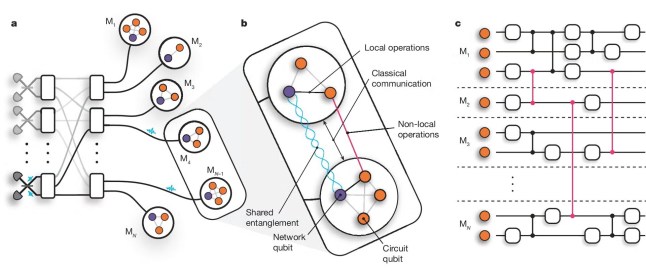 What the study means by ‘teleporation’ isn’t quite the same as being beamed up (Picture: Nature)‘In the long run,it could enable much more powerful systems capable of solving problems that are far beyond the reach of today’s best supercomputers,such as in areas like drug discovery,materials design,and encryption,’ he said.Sadly,Main said that while the word ‘teleportation’ is used,‘it’s not quite Star Trek’.‘Nothing physical is being moved from one place to another,’ he said.‘What we’re “teleporting” is information by allowing two arbitrarily separated systems to talk to one-another as if they were directly next to each other.‘In simple terms,we made it possible for two distant quantum computers to run a joint operation as if they were a single machine – something that’s never been done between processors like this before.’For Main,his team’s findings are an important leap – a quantum leap – towards building large-scale quantum computers.This could be used to power advances in artificial intelligence,create new medicine and solve mathematical head-scratchers in a flash.‘Right now,we’re still in the early stages of this technology,’ added Main,‘but each advance – like linking two quantum processors – brings us closer to truly large and powerful quantum systems.’A version of this article was originally published on February 11,2025.
United News - unews.co.za